Return to
Home Page
|
(Note: This material is copyrighted.
Please see our copyright notice.)
An ever-expanding web
Teaching the hero�s journey
pattern
by Reg Harris
(co-author, The Hero�s Journey: A Guide to Literature and Life)
Click on any image to return to the top of the page.
The Journey toward the journey
During the past ten years, which is how long I have been teaching the
Hero�s Journey as a foundation unit, I have tried many ways to describe
the unending, cyclical nature of the Hero�s Journey pattern.
For a long time, I used an ascending spiral, with each loop representing
a journey in life that takes us to higher and higher levels of consciousness
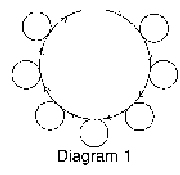
and understanding. Then I added another diagram, a large journey circle,
representing a person�s life, with a number of smaller circles looping
out from it at various points to represent the many smaller journeys we
take during our lives (diagram one).
Although these images seemed to get the idea across, I was not fully
satisfied with them. For one thing, they implied a movement of consciousness,
of the "I" in which all of our thought and perception is grounded. In
reality, the "I" doesn�t move. It expands.
Then I read something that gave me a new way to look at the process.
In The Hero Within, Carol Pearson writes, ". . . it is not so much
that the spiral gets higher, but that it gets wider as we are capable
of a larger range of responses to life and, hense, able to have more life.
We take in more and hove more choices."
The Journeys in our lives do not form a big circle or an ascending
spiral. The journey taken by the "I" is a process of ever-expanding awareness,
during which we encounter challenges and temptations. We expand our concept
of self to understand and assimilate them, not so much to confront and
destroy them. This insight led to a new diagram, which is the one I use
now.
New image of the journey
When I present the Journey in seminars with other teachers or teach
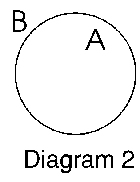
it to students, I draw a single circle (see diagram two) to represent
the "I", or rather the range of experience and understanding which we
perceive as "I". Within that circle are the experiences we�ve had, the
things we�ve learned, echoes from childhood that still color our thinking
and action, and our personal mythology (the plot of the story we are living)
-- all of which gives us the perception of who we are. If we are to grow,
that circle must remain flexible.
As long as our experiences fall within that range of perception (letter
A) -- that is, within the boundaries we have defined as "I" -- we are
relatively comfortable. The experience is familiar to us and we can handle
it. However, when an experience falls outside of the our range of experience
(letter B), it presents us with two options: to reach out and assimilate
it or to put up our defenses and reject it.
If we ignore or reject the experience, the circle becomes not a flexible
line of definition, but a defensive wall between our self and the world
around us. Unfortunately, when we build a wall to keep experience out,
that same wall keeps us in.
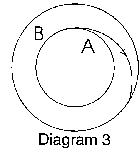
Our other option is to journey outside our self by keeping the circle
fluid (diagram three). In this way we can expand outward (painful and
frightening though this growth may be at times) until the circle of self
meets that new challenge, knows it, and assimilates it into the self.
If the journey has been complete, the product of this expansion is not
simply the original self enlarged by the experience. It's an entirely
new self, a synthesis of the former, unfolding self and the rich experience
of life.
Stagnation or expanding awareness
When I talk with students about rejecting the call to growth, I make
the circle thick, like a wall. Then I ask them what happens to the person
who hides within this ever-thickening wall. The answers can be extremely
surprising and perceptive. Students seem to recognize that such a rejection
can lead to defensiveness, stagnation, and bitterness. Such a person becomes
a victim of his own fear, a martyr to an intractable ego.
I also emphasize how much courage it takes to keep the circle fluid,
ready to embrace and assimilate new experience. To do this we must be
willing to say that we are fallible, that we may not know everything,
that we are not perfect. We must be willing to accept the fact that our
model of the world may be flawed or ineffective.
As long as we can do these things, challenges become growth experiences,
enriching our understanding and enhancing our abilities. The people who
represent or contain the challenges become helpers or mentors on our journey
outward. When we can�t remain fluid, the challenges become threats to
the fearful self, objects to be fought and kept out, and the people who
represent those challenges become tyrants, devils and attackers.
Circles within circles
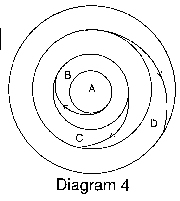
In the classroom, as my discussion of this concept continues, I draw
more experiences outside each circle and enlarge the circle to assimilate
those experiences. Soon I have a diagram with circles within circles,
illustrating how we grow with experience (diagram four). It looks very
much like the rings on a tree, an image which suggests some other interesting
connotations.
Incorporating the mandala
Incorporating the mandala with this "circles within circles" image
of the journey adds a valuable dimension to this concept. The mandala
is a circle which, in the personal context, represents the world of the
self. Within it are arranged the symbols and images of the self. Symbolically,
then, the journey can be seen as the mandala growing to absorb new symbols
and images. (Note: There is a unit on creating a personal mandala in The
Hero�s Journey: A Guide to Literature and Life)
This approach also emphasizes that our experiences are always going
to be with us, working for us or against us in our growth and understanding.
What becomes important, then, is not so much the experience, but how we
relate to it, how we see it in the mandala of self.
Connecting life and literature
I apply this expanding self model (including the mandala) to characters
from literature and film. I have students do mandalas on characters, incorporating
symbols and images which represent different aspects of the character�s
experience, perception or life. The mandala helps them understand and
analyze the character and his or her motivations.
Moreover, when the students place the challenges outside of the character's
mandala, they can begin to see how (or if) the character handles these
challenges and grows. They can also see how the circles of one character
interconnect with another character, much like a Venn diagram.
This way of describing the Hero�s Journey seems to work well on a number
of levels and is a technique worth considering, even if you don�t teach
the Journey pattern as a foundation unit.
- Return to top of page
| Go to Workshop
|
|