
 Return to
Home Page
|
The Call Refused
(This article an example of the student materials from
The Hero's Journey: A Guide to Literature and Life by Reg Harris
and Susan Thompson. It is published here to illustrate the curriculum
and MAY NOT BE COPIED. Copyright 1997 by Ariane Publications. All
rights reserved. Go to Ordering Information
for information on ordering the curriculum. Go to Teacher's
Guide for information on the teacher's guide which is the foundation
of the curriculum. Please respect my copyright
and my work. Do not copy this material.)
Refusing the adventure
You have studied the importance of the Rite of Passage. You know how
journeys help develop confidence and skill. You've seen journeys and rituals
mirrored in myth, literature and film. But what happens if someone refuses
the Call and avoids the journey? What then does life become?
Just think about the heroes of some of the stories you've read or movies
you've seen. What if Simba in The Lion King had ignored Nala and
Rafiki and not returned to Pride Rock? How would he have felt when he
looked up at the stars? And what about Lieutenant Dan in Forrest Gump?
What if he had rejected Forrest's offer to be first mate on his shrimping
boat? How would his life have been different?
Death and rebirth
Remember that both the Journey and the Rite of Passage require a death
and rebirth: the death of the childish, ego-centered "I" and the birth
of the mature, society-oriented "we." The initiate stops insisting, "Me,
me, me," and becomes a part of his community. He stops crying, "Unfair,"
and starts thinking, "I can handle this." She stops claiming, "It's not
my fault," and begins saying, "I am responsible for my own life and feelings."
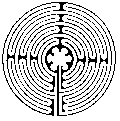
Into the labyrinth
When someone refuses the Call, he is refusing his own innate need to
grow. He is rejecting the power and freedom that come with "rebirth."
Rejection turns situations which should have been empowering into their
opposites. A journey which would have liberated the hero enslaves him
instead. The adventure which would have given confidence and power causes
dependence and fear. The quest which would have made him open and giving
makes him bitter and suspicious.
By rejecting growth, the non-hero surrenders his ability to act even
in his own interest. Nothing he does helps. There is only a growing sense
of desperation and frustration. The challenge is no longer growth and
discovery, but self-defense, the protection of his ego, values and advantages.
Even those figures such as parents and teachers, who want to help, become
images to be avoided and resisted.
Perhaps the non-hero will be lucky and find a Nala or Forrest to lead
him out. Or perhaps the predicament created by his refusal will offer
one last chance, carry the seed for his salvation. If not, every time
the non-hero looks at the journey not taken, he will feel guilt, anger,
self-pity, bitterness, and isolation. In extreme cases, his world may
end in self-destruction.
The stuff of tragedy
The classic myths and legends are full of people who have refused the
call: King Minos, Peter Pan and the Lost Boys, Daphne, and many others.
Literature, too, is populated with non-heroes who die in the labyrinth
of the quest refused: Willy Loman in Death of a Salesman, the young
lovers in Shakespeare's Romeo and Juliet, Bob Ewell in To Kill
a Mockingbird.
Even our movie screens are filled with characters who have locked themselves
in the labyrinth, with its greed, fears and compulsions: Phil Connors
in Groundhog Day, Peter Pan in Hook, and Scar in The Lion King.
Their message is hope
If these people are non-heroes, why do we need their stories? Perhaps
it's because by studying their failed journeys, we can better understand
our own fears and weaknesses. By charting the deadends in their lives,
we will be better able to chart a successful path through our own. We
will see that the path is well marked, if only we will follow the signs.
Finally, by understanding their isolation and bitterness, we will realize
that we need not travel alone, that help is available, if we are wise
enough to accept it.
(Click boat to return to the top of the page.)
|
|
