 (Note:
this material is copyrighted. Please see our copyright
notice.) (Note:
this material is copyrighted. Please see our copyright
notice.)
The Hero's Journey:
Curriculum Outline
|
| The Hero's Journey:
A Guide to Literature and Life is a comprehensive program
which incorporates literature, film, art and speech under a unified theme
with a logical progressive structure. The curriculum contains ten units
and 14 lesson plans, and includes all of the text, stories, copy masters,
and forms you need for up to a full year of teaching. It may be
used in part or in its entirety. The following outline will give you a
clear idea of the curriculum's inclusiveness and progressive nature.
|
Unit
|
Material Covered
|
Activities
|
Ritual and Rite of Passage
|
- Ritual and Rite of Passage (handout)
- Ritual and the Creation of Meaning (NEW)
- Film: Star Wars (or other Hero's Journey film)
- Blackfoot legend: The Buffalo Dance
|
-
Discussion: Teenagers and Modern Rites of Passage
-
Questions for review
-
Create your own ritual for a modern "life transition"
|
The Hero's Journey
|
- The Hero's Journey: outline and explanation of the
stages and their relationships to literature and life (handout)
- A history of research and analysis on the heroic
journey pattern, including extensive sections on the Jungian hero
archetype and Joseph Campbell (NEW).
|
-
What makes a hero? (brainstorming and discussion.
-
Athletes, actors and actresses, and victims as heroes (discussion)
-
Elements of the Journey: notetaking, discussion and film
|
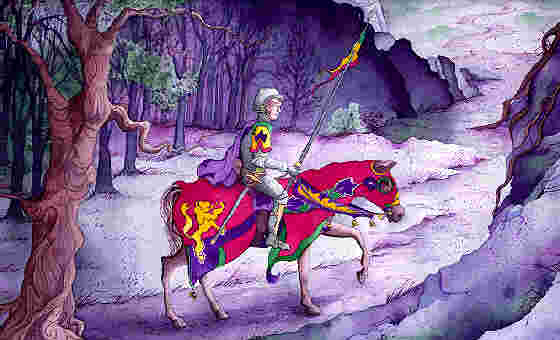
Gawain and the Green Knight
|
-
The Legend of Gawain and the Green Knight (handout)
|
-
Background: Gawain, King Arthur, the Round Table (lecture)
-
Log Gawain's Journey (activity)
-
Understanding the Nature of the Challenge (study questions)
-
Interpreting stages of the Journey (discussion)
|
Demeter and Persephone
|
-
Myth: The End of Eternal Spring (handout)
|
-
Quests and the importance of compromise (discussion)
-
Mythology based vocabulary
-
Demeter's and Persephone's compromise (discussion and reflection)
-
Writing about compromise (short reflective essay)
|
The Legend of Buddha
|
- The Legend of Buddha (handout)
- Film: The Little Buddha (optional)
- Buddhist Non-Attachment and the Hero's Journey (NEW)
|
-
Understanding mythological motifs, archetypes and metaphors
(discussion)
-
Historical context: The Axial Age
-
The Message of the Return, sacrifice and responsbility (discussion
and reflection)
-
Understanding Buddha's journey (review questions)
-
Analyzing The Little Buddha: Tibetan Buddhism, reincarnation,
death as a journey, the father's journey (discussion)
|
Field of Dreams (film unit)
|
|
-
Group collaboration: notetaking, analysis and presentation
-
How our Journeys interlock (discussion and reflection)
-
Log Ray Kinsella's Journey (activity)
-
Understanding transformation: charting a characters growth
-
Character analysis (major essay)
|
Write a Hero's Journey Short Story
|
- Step-by-step directions for writing your own short
story (handout)
- Directions for using short stories or films (from
your own curriculum)
|
-
Write your own short story using the Hero's Journey pattern
as a foundation
-
Inventing and developing character, building setting and
creating conflict (exercises from text)
-
Sentence modeling exercises for describing scenes and writing
dialogue (from text)
-
Peer response editing (forms in text)
|
The Call Refused
|
- The Call Refused: What happens when we reject the
call to adventure (handout)
- Groundhog Day (film)
-
The Myth of Minos and the Minotaur (handout)
|
-
"What if...?" (How would the lives of heroes differed if
they had refused their calls?) (discussion)
- Understanding the need for accepting your calls:
Groundhog Day discussion
- Analyzing Groundhog Day (review questions
from text)
-
Understanding how refusing your call affects others (discussion
of Minos myth)
-
Writing about a call you refused (short, informal essay)
|
Hero's Journey Presentation
|
-
Group activity: research non-Greek/non-Roman myths for a
class presentation (instructions in workbook)
-
non-Greek/non-Roman myths (from your curriculum or library)
|
-
Find a non-Greek/non-Roman heroic myth (student research
activity)
-
Group collaboration, rehearsal and presentation of the myth
(group activity)
-
"A Member of the Team" (group self-evaluation)
|
My Journey:
A Personal Mandala and
Autobiographical Essay
|
- Personal mandala pre-writing exercise
(from teacher's manual), including two NEW
pages on the philosophy of the mandala and using mandalas in the classroom.
- Directions for essay-writing project
|
-
Using the mandala as a window to self-discovery (discussion
)
-
Using the mandala to analyze charcters from literautre and
film (discussion and activities)
-
Revealing self through symbol and metaphor (discussion)
-
Finding the shadow self: personal qualities chart (activity)
-
Creating your own mandala (activity)
-
Writing a reflective essay about a heroic journey you have
taken
|